
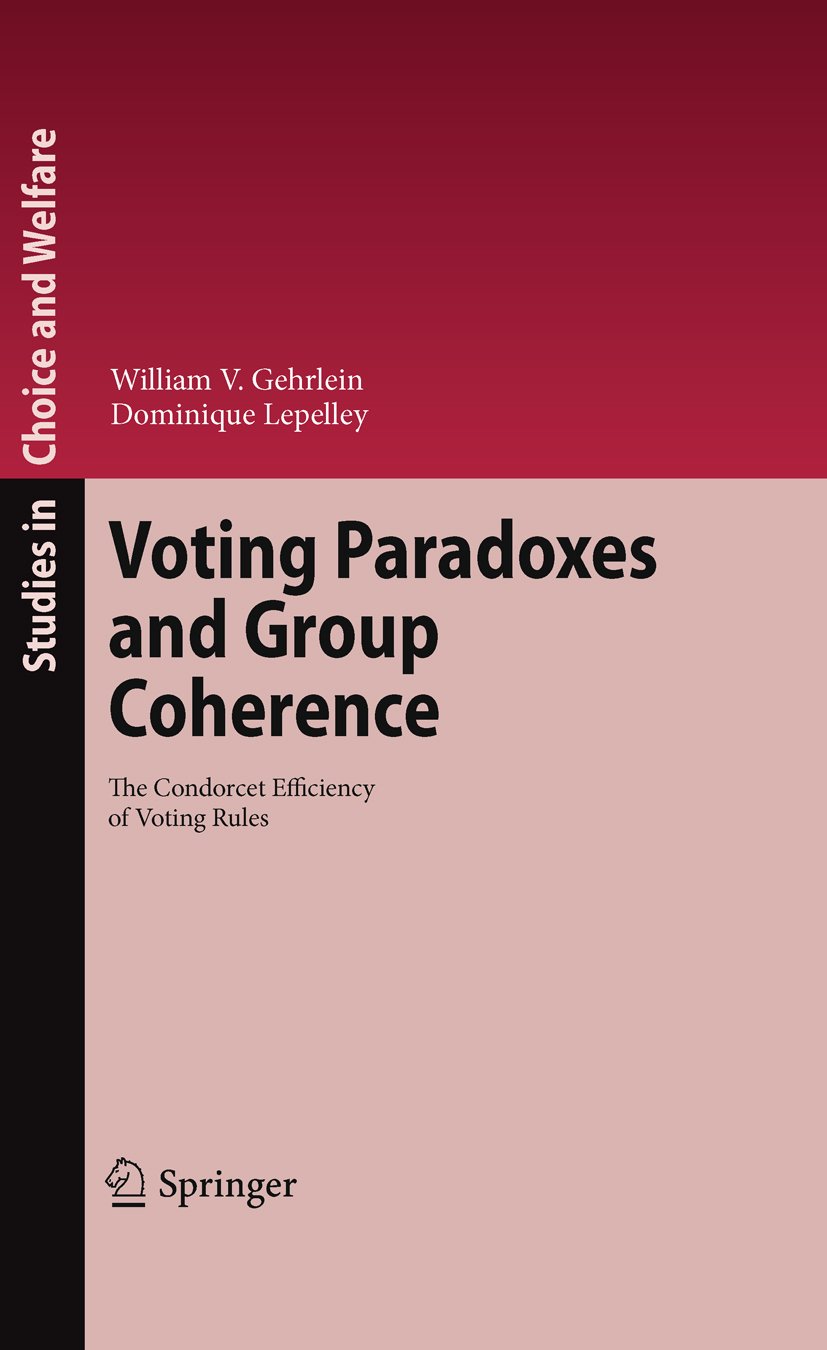
Voting Paradoxes and Group Coherence: The Condorcet Efficiency of Voting Rules (Studies in Choice and Welfare)
Product details
| Management number | 232066535 | Release Date | 2026/06/18 | List Price | US$35.58 | Model Number | 232066535 | ||
|---|---|---|---|---|---|---|---|---|---|
| Category | |||||||||
The likelihood of observing Condorcet's Paradox is known to be very low for elections with a small number of candidates if voters’ preferences on candidates reflect any significant degree of a number of different measures of mutual coherence. This reinforces the intuitive notion that strange election outcomes should become less likely as voters’ preferences become more mutually coherent. Similar analysis is used here to indicate that this notion is valid for most, but not all, other voting paradoxes. This study also focuses on the Condorcet Criterion, which states that the pairwise majority rule winner should be chosen as the election winner, if one exists. Representations for the Condorcet Efficiency of the most common voting rules are obtained here as a function of various measures of the degree of mutual coherence of voters’ preferences. An analysis of the Condorcet Efficiency representations that are obtained yields strong support for using Borda Rule. Read more
| ASIN | B00F758JTM |
|---|---|
| XRay | Not Enabled |
| ISBN13 | 978-3642031076 |
| Edition | 2011th |
| Language | English |
| File size | 21.3 MB |
| Page Flip | Enabled |
| Publisher | Springer |
| Word Wise | Enabled |
| Print length | 770 pages |
| Accessibility | Learn more |
| Screen Reader | Supported |
| Part of series | Studies in Choice and Welfare |
| Publication date | November 11, 2010 |
| Enhanced typesetting | Enabled |
Bestseller ranking
All Postpaid Phones






Customers who viewed this product also viewed
Game Theory



Correction of product information
If you notice any omissions or errors in the product information on this page, please use the correction request form below.
Correction Request Form